
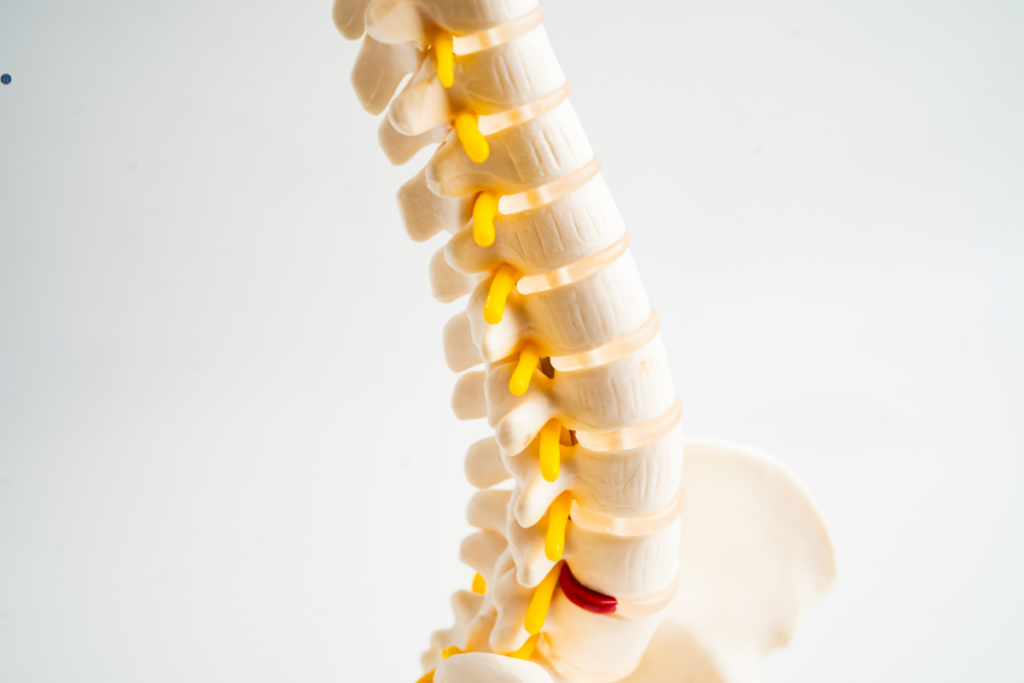
Most people picture spinal degeneration as something that only affects the elderly — a slow, inevitable process reserved for old age. In reality, at Dee Why Chiropractic Care we see the early stages of spinal degeneration in patients in their 20s and 30s, often driven by nothing more dramatic than years of poor posture, an old injury that never fully healed, or a desk job that keeps the spine loaded in the same position for eight hours a day.
The good news is that spinal degeneration follows a predictable pattern, and understanding where you sit in that pattern is the first step toward slowing it down. Here’s what’s actually happening inside your spine, and what a Dee Why chiropractor can do about it.
What Is Spinal Degeneration?
Your spine is a stack of 24 moveable vertebrae, cushioned by discs and held together by ligaments, muscles, and small joints called facet joints. When everything is aligned and moving well, load is distributed evenly across these structures. When alignment or movement is compromised — through injury, poor posture, or repetitive strain — certain areas of the spine start to bear more load than they’re designed for. Over time, this uneven stress causes the discs, joints, and surrounding tissue to wear down. That wearing-down process is spinal degeneration, and chiropractors typically describe it in three distinct phases.
The 3 Phases of Spinal Degeneration
Phase 1: Dysfunction
This is the earliest and most treatable stage. The normal curve and movement pattern of the spine starts to shift — often because of a poorly healed injury, chronic poor posture, or muscle imbalances pulling the spine out of its ideal alignment. The discs and joints begin taking on abnormal stress, and the surrounding muscles and ligaments start to weaken as they compensate.
The tricky part about Phase 1 is that it rarely hurts. Most people feel completely fine, so there’s no obvious reason to seek help. This is exactly why it’s so often missed — and exactly why it’s the phase where intervention makes the biggest difference. At this stage, improving posture, restoring normal joint movement, and correcting alignment can meaningfully change the trajectory of the spine before any permanent structural damage sets in.
Phase 2: Dehydration and Instability
After months or years of abnormal loading, the discs — which are largely made of water — begin to lose hydration and height. As the discs thin, the space between vertebrae narrows, joint surfaces start to roughen, and the body begins laying down early bone spurs (osteophytes) as a stabilising response to the increased instability.
This is usually when symptoms start appearing: stiffness, reduced range of motion, and intermittent aches that seem to come and go without an obvious trigger. Many patients describe it as “my back just isn’t what it used to be.” Treatment at this stage is still highly effective, but the goal shifts slightly — it’s now as much about protecting what mobility remains as it is about correcting the underlying cause.
Phase 3: Stabilisation
This is the body’s last-resort response to years of instability. Bone spurs enlarge, joint spaces narrow significantly, and in some cases the spinal canal itself narrows (spinal stenosis), which can put pressure on nerves. The body is effectively trying to fuse and stabilise the area to stop further damage — but the trade-off is a significant, often permanent, loss of mobility.
Symptoms at this stage tend to be more constant and can include chronic stiffness, nerve-related pain, tingling or numbness into the arms or legs, and a noticeable reduction in day-to-day function. Structural changes at this point generally can’t be reversed, but that doesn’t mean nothing can be done — care shifts toward managing symptoms, maximising remaining mobility, and preventing surrounding areas of the spine from degenerating further.
How Injury and Posture Accelerate the Process
Degeneration is, to some extent, a natural part of ageing — but the speed at which it progresses is heavily influenced by mechanical factors within our control.
An injury that isn’t properly rehabilitated — a car accident, a sporting injury, even a fall from years ago — often leaves behind subtle compensations. The body finds a way to keep moving, but usually by shifting load away from the injured area and onto neighbouring joints and discs, accelerating wear in places that had nothing to do with the original injury.
Posture works the same way, just more slowly. Hours spent hunched over a laptop or phone, sitting with poor lumbar support, or standing with uneven weight distribution all place sustained, abnormal pressure on specific discs and joints. Unlike an acute injury, poor posture doesn’t announce itself — it just quietly compounds, day after day, until the spine reflects years of that loading pattern.
Symptoms and the Impact on Quality of Life
Depending on the phase and the area of the spine affected, degeneration can show up as stiffness that’s worse in the morning or after long periods of sitting, a gradual loss of flexibility, localised or referred pain in the neck, mid-back, or lower back, headaches originating from neck tension, and — in more advanced cases — nerve-related symptoms like tingling, numbness, or weakness radiating into the arms or legs.
Beyond the physical discomfort, this kind of chronic, creeping change tends to affect quality of life in ways that are easy to underestimate. Sleep becomes harder when you can’t find a comfortable position. Exercise and hobbies get scaled back to avoid aggravating symptoms. Simple tasks — picking up a grandchild, gardening, sitting through a full workday — start to feel harder than they should. Because the changes happen gradually, many people adjust their lifestyle around the pain without realising how much they’ve given up.
How Chiropractic Care Can Help
Chiropractic care can’t undo degenerative changes that have already occurred in the later phases — no treatment can. What it can do, particularly in Phases 1 and 2, is address the mechanical factors driving the degeneration in the first place: poor alignment, restricted joint movement, muscular imbalance, and postural stress.
By restoring more normal movement and alignment to the spine, our chiropractors can reduce the abnormal loading on discs and joints that’s accelerating wear. This won’t reverse the clock, but it can meaningfully slow the rate of progression, reduce symptoms, and help preserve function and mobility for longer — which, for most patients, is exactly the outcome that matters.
Treatments We Use at Dee Why Chiropractic Care
We tailor treatment to the phase of degeneration and the specific findings of your assessment, but the tools we most commonly draw on include:
Chiropractic adjustments to restore normal joint motion in areas that have become restricted or fixated, reducing compensatory stress on neighbouring segments.
Flexion-distraction therapy, performed on our specialised table, which gently decompresses the spine and creates space within the disc and joint spaces — particularly useful for disc-related issues and early-stage instability, without the forceful thrust of a traditional adjustment.
Dry needling to release tight, overactive muscles that are compensating for poor joint mechanics and contributing to abnormal loading patterns.
Cupping therapy to improve blood flow and reduce muscular tension and fascial restriction around chronically stressed areas of the spine.
Active Release Technique (ART) to break down adhesions and restore normal length and function to muscles and soft tissue affected by long-term compensation patterns.
Used together, these approaches address both the joint mechanics and the surrounding soft tissue — because lasting improvement rarely comes from treating one without the other. Here’s a quick look at one of these techniques in action:
Frequently Asked Questions
Can chiropractic care reverse spinal degeneration?
No — once discs and joints have degenerated, that structural change can’t be undone. What chiropractic care can do is address the postural and mechanical factors accelerating the process, which can slow further progression and improve symptoms and function.
What are the early signs of spinal degeneration?
Early Phase 1 changes often cause no pain at all, which is why they’re usually only picked up during a proper spinal assessment. As it progresses into Phase 2, stiffness, reduced flexibility, and intermittent aches typically start to appear.
Is spinal degeneration the same as arthritis?
They’re closely related. Degenerative changes in the spine’s facet joints are a form of osteoarthritis, caused by the same wear-and-tear process that affects other joints in the body.
How often should I get my spine checked?
Because Phase 1 degeneration is usually painless, we recommend a periodic spinal assessment even if you’re not currently experiencing symptoms — particularly if you sit for long periods at work, have a history of sporting injuries, or have noticed your posture changing over time.
Book a Spinal Assessment in Dee Why
If it’s been a while since your spine has been assessed — or if you’ve noticed stiffness, reduced flexibility, or aches that seem to be becoming more frequent — it’s worth having it looked at properly rather than waiting for pain to force the issue. We proudly serve patients across Dee Why, Curl Curl, Cromer, Narraweena, Beacon Hill, and North Manly.
Dee Why Chiropractic Care
Shop 4, 1–3 Sturdee Parade, Dee Why NSW 2099
(02) 9971 9428 | www.deewhychirocare.com.au